New Class Pet: Sir Bunsen Pascal
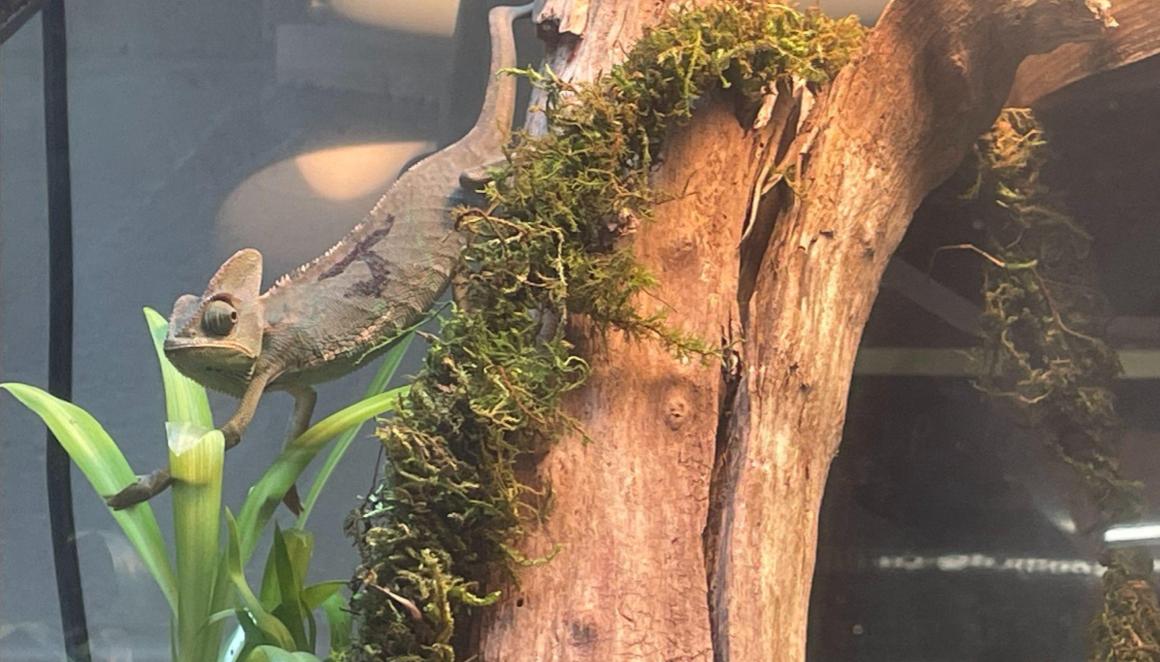
Sir Bunsen Pascal lives in his lively habitat found in Dr. Lee's room (Photo: Martin Cervantes Pacheco).
A new addition to the science hallway has been added: Sir Bunsen Pascal. He is in Dr Lee's room and, not only is Bunsen Pascal an interesting and cute animal, but he is also loved by many. His name is an homage to the scientist Robert Bunsen and the chameleon from the movie Rapunzel, named Pascal. Bunsen Pascal is a male veiled chameleon and, as of writing this, he is three months old. But what exactly is a veiled chameleon like?
The veiled chameleon's natural habitat is the semi-arid and tropical South-western Arabian peninsula. Despite this, it lives in 40-50% humidity and is arboreal, living among the trees. Veiled chameleons can be found in many different places, such as plateaus, mountains, and valleys. They can reach sizes up to 24 inches for males and 14 inches for females. The veiled chameleon is omnivorous, though it prefers insects and rarely eats vegetables or fruits, and thus is often referred as insectivorous. However, the veiled chameleon is highly susceptible to stress which makes it hard to domesticate. When under stress, it hisses, puffs, and turns into a dark color.
Like all chameleons, the veiled chameleon can change color due to guanine nanocrystals which are in a two layer structure. The chameleon can space out these layers, and so when it is relaxed, the layers are “closed” and reflect back blue and green light due to their short wavelengths. When under stress, the opposite happens as the layers are apart and reflect long wavelengths like red, orange, and yellow.
Veiled chameleons are actually known for their capable camouflage and using color to show emotion. Color can also show the strength of a chameleon, seen when the males fight. They brighten their colors on both their bodies and stripes as a signal of aggression. The longer this coloration lasts, the stronger a bite is. Coloration on the top of a chameleon's head shows the tendency to win and change of coloration shows the end result of a fight, with quicker changes meaning a likely win. This type of behaviour lets both sides of the combat save energy and time.
Camouflage isn't the only interesting thing about veiled chameleons. They have a tongue which is twice its size and eyes which have 360 degree vision and separate movement. These skills allow them to hunt insects and evade predators easily. It also has a prehensile tail (a tail that can hold or grab things), allowing it more movement. Due to the way it has adapted to its environment, it is clear that the veiled chameleon is an interesting and wonderful animal, but how do students feel about Bunsen Pascal?
In short, they love him. All students stated they liked him, and one special and eccentric student was very ecstatic about him. “I absolutely adore him,” Hendricka Fischer said, “I would love to have a chameleon just like him.” Audrey Siefker stated everyone's sentiment best: “You just gotta love him.”