How Does What You Post Online Affect You?

What's a digital footprint, and what can the consequences to your actions be?
What's a digital footprint?
Whenever you post a photo, like something, or search for something online, that is your digital footprint. A digital footprint is the data you leave behind when you use the internet, and it could follow you for the rest of your life. If you aren't careful about your digital footprint, it could affect you.
Emails, search history, online purchases, and social media posts are all examples of your digital footprint. Some footprints can be intentional, while others may not be. Some browsers can collect things like your Search history or your interests, which can be used against you.
How can it affect you?
Almost all job employers or colleges do a background check on you before even thinking of accepting you into their college or hiring you. According to business news daily, in a survey conducted by the harris poll 70% of the employers said that they believe every company should check somebody's social media profile before hiring them. The most checked sites are LinkedIn, Facebook, Instagram, Twitter, TikTok, and WhatsApp.
Some people think that they can just delete a post, and it will never be seen again. That is wrong. Most of your online data is collected and archived for employers and colleges to see. According to a Harvard Business Review, Around fifty percent of job employers reject a candidate because of something they found online. Even though you may have gotten into a college, the college can take back their offer if they find out something that may make you look bad.
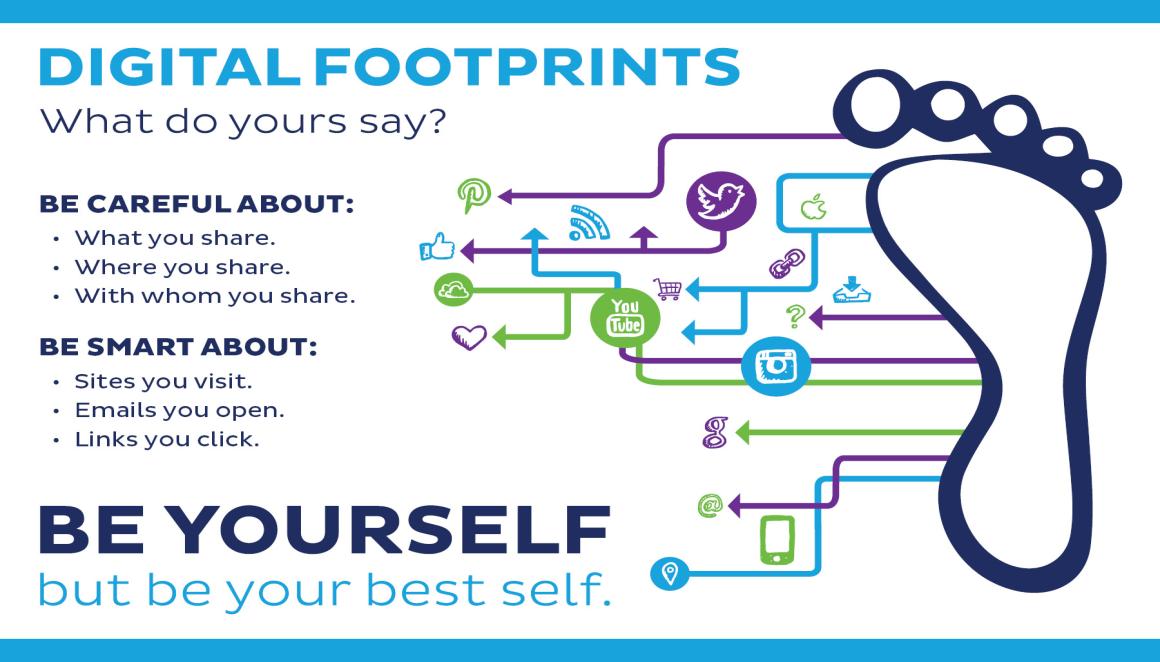
How can you be careful about your footprint and how much you share?
How can it affect your privacy and security?
Some people think that they can just delete a post, and it will never be seen again. That is wrong. Most of your online data is collected and archived for employers and colleges to see. According to a Harvard Business Review, Around fifty percent of job employers reject a candidate because of something they found online. Even though you may have gotten into a college, the college can take back their offer if they find out something that may make you look bad.
Social media apps often target their ads based on the user's behavior, this collects more data than people realize. They record your interests, shopping habits, search history, and even sometimes your location. Advertisers can buy this information and direct it to you to make you buy their products.
What's the difference between an active and passive digital footprint?
A passive digital footprint is something that you do not want to be, somebody with a passive footprint is not aware of the data they are sharing or posting, which is not good. An active digital footprint is when the user knows what they are sharing and posting, and if they ever do give information, they are aware of it.
Having an active digital footprint is better because it allows you to stay hidden, decrease the number of scams you receive on your phone, and increase your chances of getting the job you want.
So, how can i protect myself?
People take many measures to ensure their information isn’t being taken. A lot of it requires being careful about the sites you visit, what you click on, and more. Reducing your social media use can improve how protected you are. If you search for your name, you could get rid of a few profiles to limit your digital footprint.
Being careful about who you trust online is a big factor in protecting yourself. Most data breaches in big companies occur because employees are not careful. To stay protected, you can use multiple different passwords on different sites and keep them noted somewhere. Even using a VPN can make it harder for people to track your location.